Copperplate engraving
Getty Research Institute
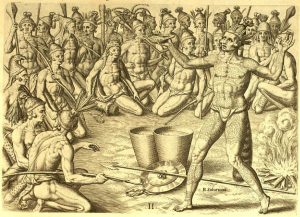
Jacques Le Moyne was a French artist and cartographer who in 1564 traveled to an ultimately unsuccessful French colony in modern-day Florida. Much of his fifteen-month stay in Florida was spent with the native Timucuans. He spent this time creating depictions of the Timucuans and making maps of the area (near present-day Jacksonville). Unfortunately, in 1565 during a Spanish siege on the French fort, Fort Caroline, Le Moyne lost the majority of his work. After sailing back to France and eventually settling in England as a Huguenot refugee, Le Moyne recreated many of his drawings from memory. Shortly after his death in 1588, his drawings were acquired and reproduced as engravings by Theodor de Bry.
De Bry’s engravings are questioned for their veracity due to their dubious connection to Le Moyne’s original drawings, but, despite their likely embellishment, they cannot be understood as complete fabrications of Timucuan culture. This particular engraving depicts a Timucuan chief preparing his soldiers for battle by preparing black drink. Black drink is a name used for various ritual drinks used by Native Americans. It usually contained a relatively large amount of caffeine or a small amount of alcohol by today’s standards.
There exists a strong cultural association between Native Americans and a biological predisposition to alcohol abuse, but modern studies are challenging that conception. Instead, scholars are looking at other factors that may have contributed to an increased rate of alcohol consumption among Native Americans in comparison to non-Native Americans. One of the factors that may explain this discrepancy is the prominence of these black drink rituals.
In pre-Columbian America, alcohol use was strictly ritualistic. Also, as we have stated previously, the alcohol content of black drink and other alcoholic beverages in pre-Columbian America was much lower than that of the alcohol brought over by Europeans. When stronger European alcohol became available in relative abundance Native peoples had no infrastructure in place for its regulation. Native Americans’ higher incidence of binge drinking may be linked to the historical use of alcohol as a ritualistic spiritual aid. This is just one of the many possible explanations for the high prevalence of Native American alcoholism. Some scholars even suggest that alcohol use evolved into a method of protest for Native Americans.
The stereotype of the drunken Indian is a prominent and harmful one for Native Americans. It paints Native Americans as immoral pleasure seekers who would rather escape from reality than adjust to the ever-changing modern world. Yes, alcohol use played a part in the decline of the Native American, but its overuse by Native Americans can be explained by a variety of cultural factors, including the nature of Native American use of black drink and other psychoactive substances.
Sources:
Dunbar-Ortiz, Roxanne, and Dina Gilio-Whitaker. “All the Real Indians Died off” : And 20 Other Myths about Native Americans. Boston : Beacon Press, [2016], 2016.
French, Laurence Armand. “Psychoactive Agents and Native American Spirituality: Past and Present.” Contemporary Justice Review 11, no. 2 (June 2008): 155–63. https://doi.org/10.1080/10282580802058270.
“Le Moyne de Morgues, Jacques (1533-1588), Artist and Cartographer | American National Biography.” Accessed December 9, 2018. http://www.anb.org/view/10.1093/anb/9780198606697.001.0001/anb-9780198606697-e-1701106.
“Theodor de Bry | Admiranda Narratio Fida Tamen, de Commodis et Incolarvm Ritibvs Virginiae : Nvper Admodvm Ab Anglis. . . (1590) | Artsy.” Accessed December 10, 2018. https://www.artsy.net/artwork/theodor-de-bry-admiranda-narratio-fida-tamen-de-commodis-et-incolarvm-ritibvs-virginiae-nvper-admodvm-ab-anglis.